
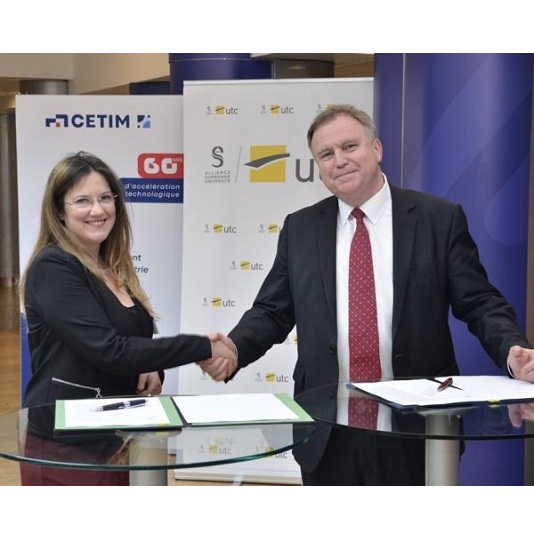
It’s official! With the signing that formalizes the creation of “CREM” (Cetim Roberval Electromobility), in partnership with University of Technology of Compiègne (UTC), Cetim now counts its eleventh joint laboratory.
In synergy with UTC’s Roberval laboratory, the teams are combining their expertise to accelerate innovation in the field of electromobility. This initiative addresses national and European energy transition challenges by turning scientific advances into operational innovations, reducing technological uncertainties specific to electric mobility, and providing long-term support to industrial players in their design, redesign and decarbonization efforts. It also reflects the shared ambition of UTC and Cetim to place collaborative research at the heart of industrial development, recognizing its decisive role in fostering cooperation and transforming research into economic and technological value.
A Laboratory at the heart of industrial transformation
CREM brings together the scientific strengths and expertise of UTC’s Roberval Laboratory and Cetim’s Research Centre, operating at the interface with industry.
More specifically, CREM aims to :
- tackle the multiphysics challenges associated with electric mobility,
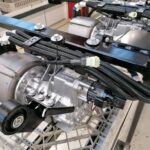
- deepen research into the vibroacoustic and psychoacoustic issues of electric vehicles,
- accelerate the development of models, test methods and demonstrators that meet industrial needs, particularly in the off‑road, automotive, rail and mechanical equipment sectors.
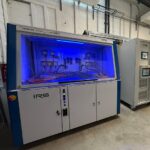
The laboratory operates under an integrated collaborative framework, mobilising the platforms, know-how, human resources and technical facilities of both partners. Crem also contributes to Cetim’s E‑Mobility technological investment project, designed to strengthen innovation and technology transfer capabilities for the benefit of industry.
Collaborative Research: A Strategic Driver of Industrial Competitiveness
The creation of CREM comes at a time when collaborative research is increasingly recognized as a decisive driver of industrial sovereignty and innovation. Bringing academic laboratories closer to industrial needs is indeed a key condition for turning scientific advances into competitive products, processes and technologies.
Certified as a Carnot Institute since 2006, Cetim has been developing joint laboratories for more than 25 years, dedicated to strengthening the scientific and technological foundations of mechanical engineering companies. CREM is thus Cetim’s 11th joint laboratory, further reinforcing a framework that is unique in France and fully dedicated to supporting the sector.
Daniel Richet, Chief Executive Officer of Cetim, explains: “With CREM, we are creating a high-level scientific tool to support manufacturers as they address the profound transformations of low-carbon mobility. This initiative fully aligns with our 2024–2027 roadmap and will help remove key scientific barriers to innovation in the mechanical engineering industries. Research is a strategic investment that must be pursued over the long term. This new partnership with UTC strengthens a long-standing collaboration and enables us to anticipate industrial changes, secure skills, and transform scientific advances into value for the entire mechanical engineering sector.”
“This joint laboratory, the result of a strategic and long-standing collaboration between UTC and Cetim, illustrates the strength of the complementarity between UTC’s academic research and Cetim’s operational expertise,” adds Claire Rossi, President of UTC. “By pooling our platforms, teams and know-how, we are enhancing our ability to address the technological challenges of electromobility and to support manufacturers through their transformations. This integrated approach – linking research, innovation and training in close alignment with socio-economic needs- is deeply rooted in UTC’s DNA. CREM is a concrete expression of this ambition: accelerating technology transfer to industry while training the engineers and researchers who will drive the transitions of tomorrow,” she concludes.
Contact us for more information !
Visit us at SIA POWERTRAIN, booth n°41 and attend our conference on “Experimental analysis of the leakage characteristics and behavior of an oil cooled electric motor L-shaped lip seal in high-speed conditions”. This presentation will address sealing issues in oil‑cooled electric motors operating at high speeds, an essential challenge for the reliability, durability and performance of electric powertrain systems.
About University of Technology of Compiègne
University of Technology of Compiègne (UTC) is a public higher education and research institution with a scientific, cultural and professional mission. A member of the Sorbonne University Alliance, UTC was founded in 1972 as an experimental university of technology. Its statutes and academic model combine the strengths of a university and an engineering school, giving UTC a unique position within the French and European higher education landscape. A true regional innovation ecosystem, regularly ranked among the leading public post‑baccalaureate engineering schools, UTC maintains close ties with society and the socio‑economic world. It anticipates companies’ research and skills needs while supporting the professional integration of its 4,400 students. Built on a pedagogy that promotes autonomy and on interdisciplinary technological research focused on innovation, UTC educates engineers, master’s graduates and PhD holders capable of understanding the interactions between technology, humanity and society. Its graduates are prepared to thrive in a highly competitive international environment, with a strong commitment to responsibility and sustainable development. This excellence is widely recognized by the socio‑economic world: 95% of companies believe that UTC effectively prepares future engineers to meet tomorrow’s challenges, and 82% consider that it fosters creativity and innovation. Through their work, UTC’s faculty members, researchers and engineers give meaning to innovation by encouraging the emergence of new scientific and technological fields and by placing entrepreneurship, educational innovation and lifelong learning at the heart of their priorities – an approach further strengthened by UTC’s membership in the Sorbonne University Alliance.